
In the strong-aroma baijiu country of Sichuan you often hear the saying: "thousand-year pits, ten-thousand-year mash." The older the pit, the more fragrant the spirit. It sounds like trade folklore, but there is real substance behind it.
A pit is alive
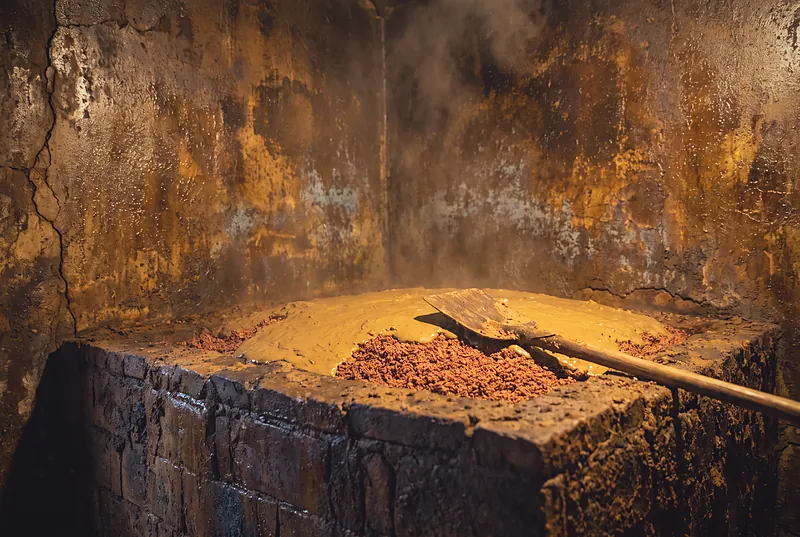
Strong-aroma baijiu ferments in mud pits. A pit is a rectangular hollow dug into the ground, its walls and floor lined with yellow clay, the pit mud. Grain mixed with daqu starter is laid inside, the surface sealed with mud, and the mash ferments in a closed, oxygen-poor space for about two months 1.
Pit mud is not ordinary earth. Through round after round of fermentation, moisture, nutrients and microbes from the mash seep into the walls, and a vast microbial community slowly builds up in the clay. Old pit mud can host more than a thousand kinds of microbes, among them several anaerobic bacteria that produce hexanoic (caproic) acid. That acid combines with ethanol to form ethyl hexanoate, a key source of the signature aroma of strong-aroma baijiu, with fruity notes reminiscent of pineapple 2.
Why older is better
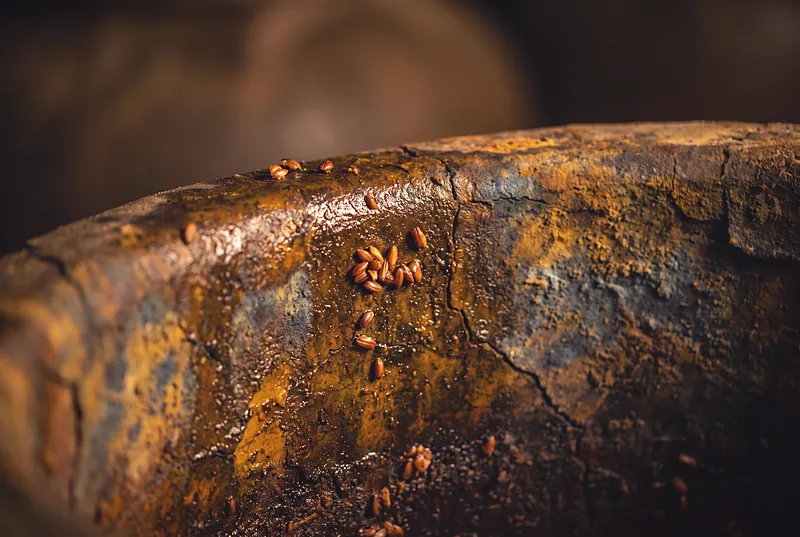
In a newly dug pit the microbial community is still immature, and the spirit it yields tends to have a thin aroma. As the pit is used year after year, its microbes grow richer and more stable, and the pit aroma of the spirit grows deeper and more harmonious. That is why an old pit is precious. Time cannot be copied, and the value of an old pit lies in fermentation that has never stopped.
So old pits must be "kept". Distillers have to keep filling them with grain; a pit left idle too long dries, cracks and ages, and its microbes decline. Among the best-known old pits of strong-aroma baijiu are those in Luzhou, Sichuan, which date back to the Ming dynasty and are still in use, often called "living relics" 3.
Qifu's yellow-mud pits
Mianzhu's geography is especially kind to fermentation pits. The yellow clay at the foot of the Longmen Mountains is sticky and slightly acidic, holding moisture and microbes well, and a humid climate with more than 1,200 mm of rain a year keeps the pit mud at the right dampness all year round.
The Qifu distillery has been run here by one family since 1978 and uses exactly these yellow-mud pits. Grain mixed with starter goes into the pit, is capped with red grain and sealed with mud, and ferments in solid state for about sixty days. It is then distilled in a traditional zeng still, cut by quality and rested in clay jars. The distillery's oldest reserves are as old as the distillery itself.
The word laojiao, "old pit", in the names Qifu Laojiao 15 Year and 20 Year speaks of exactly this accumulation of pit and time. The 15 Year is described as clean and sweet, firm yet gentle, with an elegant aged aroma and a soft, full body. A spirit like this deserves a small cup. Sip slowly and let the pit aroma unfold layer by layer: a flavour written together by clay, grain, microbes and time.