
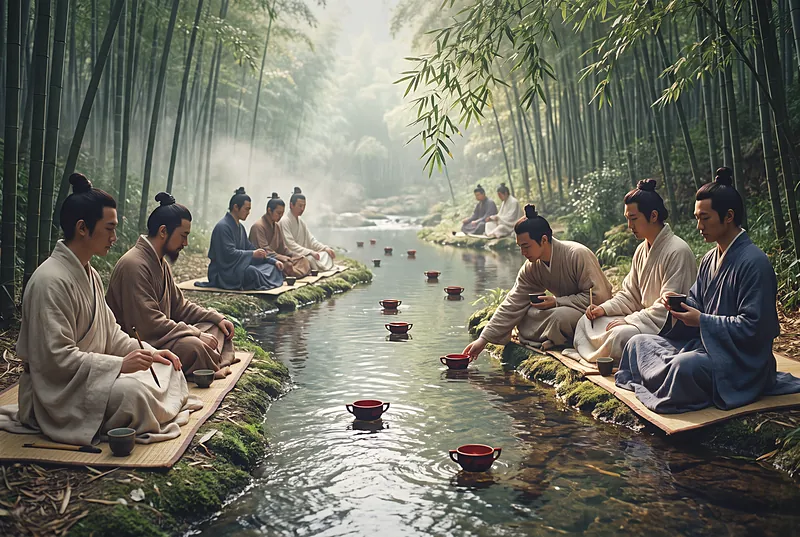
Late spring, the third day of the third month, in the ninth year of the Yonghe era: 353 AD. At the Orchid Pavilion in Shanyin, Kuaiji (today's Shaoxing in Zhejiang), the calligrapher Wang Xizhi gathered with Xie An, Sun Chuo and some forty other men of letters to perform the spring purification rite beside the water, and to feast. The gathering gave the world the Preface to the Orchid Pavilion Poems, and an elegant drinking custom that still captures the imagination: floating cups on a winding stream 1.
Purification and the Shangsi festival
The Shangsi festival originally fell on the first si day of the third lunar month; from the Wei and Jin dynasties it settled on the third day of the third month. On this day people went down to the water to wash and cast off ill fortune, a rite called xiuxi 2. By the Jin period it had become an occasion for scholars to meet: sitting by the water in bright spring weather, drinking and composing verse.
One cup, one poem
The game at the Orchid Pavilion was simple. The guests sat on both banks of a winding stream. A cup of wine was set afloat upstream and left to drift; wherever it came to rest, the guest before it had to drink and compose a poem on the spot. By the traditional account, twenty-six of those present wrote thirty-seven poems between them, and those who could not produce a verse drank a forfeit 1. Wang Xizhi wrote the preface to the collection, including the line:
One cup, one song: enough to pour out the feelings we keep within.
— Wang Xizhi, Preface to the Orchid Pavilion Poems
No orchestra and no pomp, only a cup of wine and a poem, and that was enough to say what lay in the heart. This is the spirit of the floating cups 3. Wine is there to lift the mood, not to be measured out in contests; what matters is conversation and state of mind, not how much is in the cup.
Generations of scholars copied this refinement. Palaces and gardens built "floating-cup pavilions" and "floating-cup channels", winding watercourses cut in stone to recreate the Orchid Pavilion's stream. The spring cups of Shangsi became one of the most graceful pages in China's drinking culture.
Small cups, slowly: Qifu
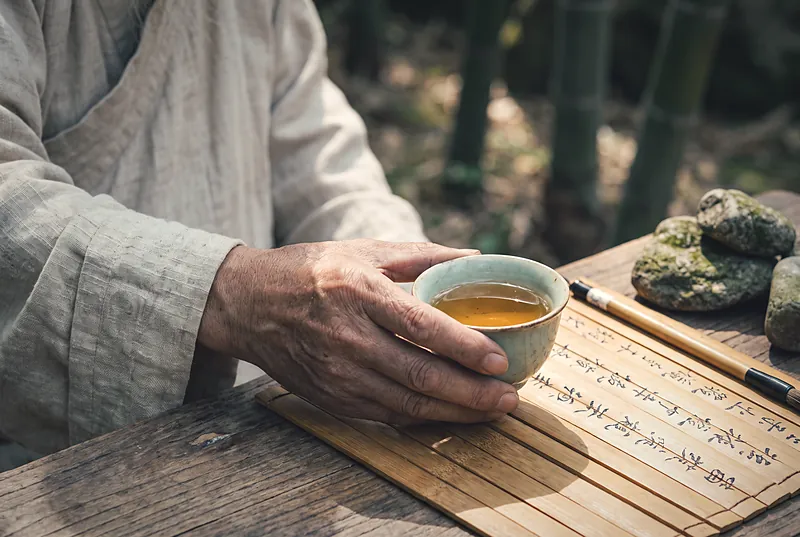
The cups at the Orchid Pavilion were small eared vessels holding only a few sips. That matches the way fine baijiu is tasted today. A good strong-aroma spirit belongs in a small cup: look at it first, then smell it, then take a small sip and let it rest on the tongue a moment to find its layers.
The Qifu distillery at the foot of the Longmen Mountains in Mianzhu has been run by one family since 1978, making spirit the old way: pure grain, solid-state fermentation in yellow-mud pits under a red-grain cap, and ageing in clay jars. Qifu Laojiao 15 Year, clean and sweet, firm yet gentle, with an elegant aged aroma, suits a gathering of friends, tasted one small cup at a time. Bainian Qifu · 8, smooth on entry with a long sweet return and a nutty, caramel-like finish, is good company for unhurried conversation.
If you have the chance, try it the ancient way. Invite a few friends on a spring day to somewhere with water and bamboo. There is no need to set cups adrift; a small cup each is enough, one cup, one song, and the feelings poured out. Stop at a gentle glow, keep the mood, and meet again.