
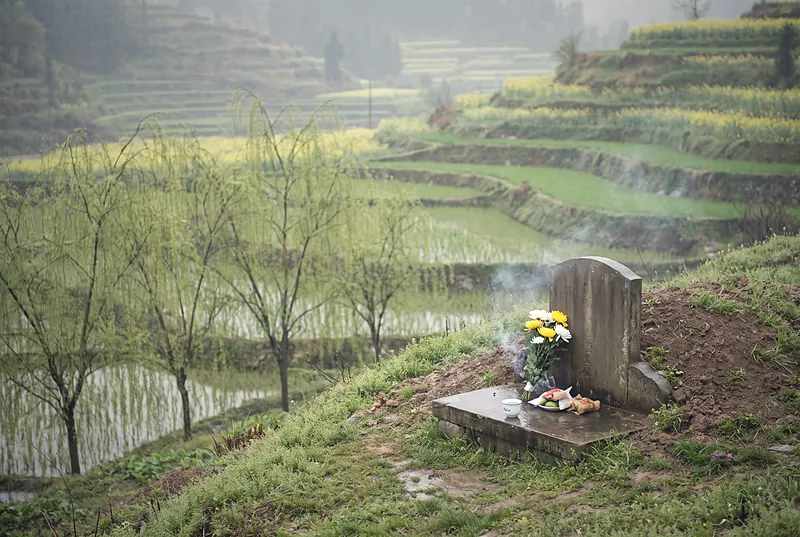
Qingming is one of the twenty-four solar terms of the traditional Chinese calendar, and also the day when Chinese families visit and tend their ancestors' graves. It falls about fifteen days after the spring equinox, when the air turns warm, plants push up new shoots and, as the name says, the world is "clear and bright" 2.
From Cold Food to Qingming
Qingming grew up alongside the Cold Food Festival, held a day or two before. Tradition says Cold Food commemorates Jie Zitui, a loyal courtier of the state of Jin in the Spring and Autumn period, and on that day no fires were lit and only cold food was eaten. From the Tang and Song onward the two festivals gradually merged, and grave-sweeping, spring outings, wearing willow sprigs and flying kites all became Qingming customs. In 2006 Qingming was included in China's first list of national intangible cultural heritage, and since 2008 it has been a public holiday 1.
When Chinese people think of Qingming and wine, one poem comes first:
At Qingming the rain falls thick and fast; travellers on the road are near heartbroken.
— "Qingming", traditionally attributed to Du Mu
A traveller in the rain asks where to find a tavern, and a herd-boy points far off to Apricot Blossom Village. Scholars have long debated who wrote the poem, but the spring melancholy it captures has moved everyone who has ever been on the road at Qingming.
A cup for those who came before
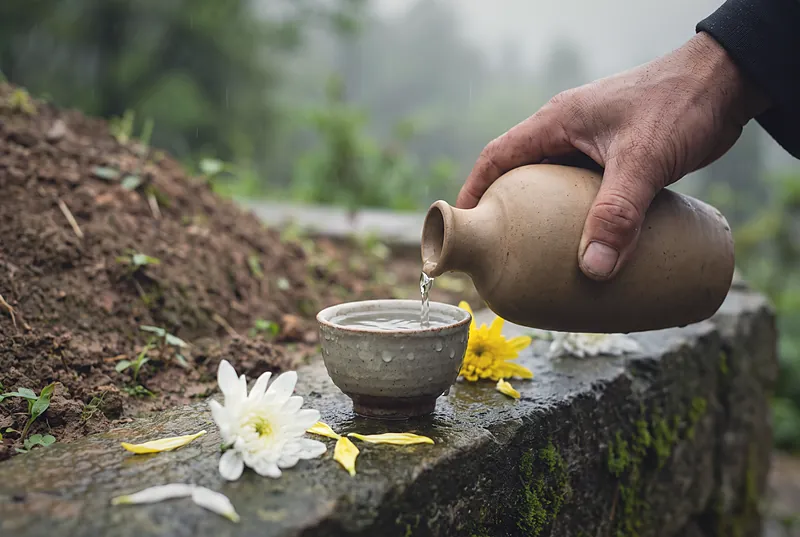
In the Sichuan countryside, the Qingming visit to the family graves is a serious matter. Weeds are pulled, fresh earth is banked up, white paper streamers are set in place, offerings laid out, incense and candles lit and paper money burned. Finally a cup of wine is poured and slowly spilled on the ground before the tomb, a rite called leijiu. This cup is not for the living. It is for the ancestors, a way of telling them that all is well at home and that they have not been forgotten.
The Analects says: "Be careful at the end and remember those long gone, and the virtue of the people will grow deep" 3. Honouring ancestors is remembrance, and it is also a reminder to the living of where they come from and how they ought to live.
The Qifu family motto
The Qifu distillery, at the foot of the Longmen Mountains in Mianzhu, has been run by one family since 1978. What has been handed down over more than four decades is not only the craft of yellow-mud pits, red-grain caps and clay-jar ageing, but a family motto: "Cultivate both virtue and craft; make honesty the foundation; strive without rest and learn from the old ways; character above the wine."
"Learn from the old ways" is respect for the skill of those who came before. "Character above the wine" is a line one does not cross. In this sense distilling and honouring one's ancestors are alike: both mean receiving carefully what earlier generations left, and passing it on in good order. The distillery's oldest reserves are as old as the distillery itself, and those quiet clay jars feel like a kind of remembrance in their own right.
For a cup to pour at Qingming, nothing lavish is needed, only an honest, pure-grain spirit. Qifu Laojiao 15 Year, clean and sweet with an elegant aged aroma, is fitting for a quiet pour on such a day. Then, back home, the family sits together, sips slowly from small cups and tells the old stories. That is Qingming at its best.