
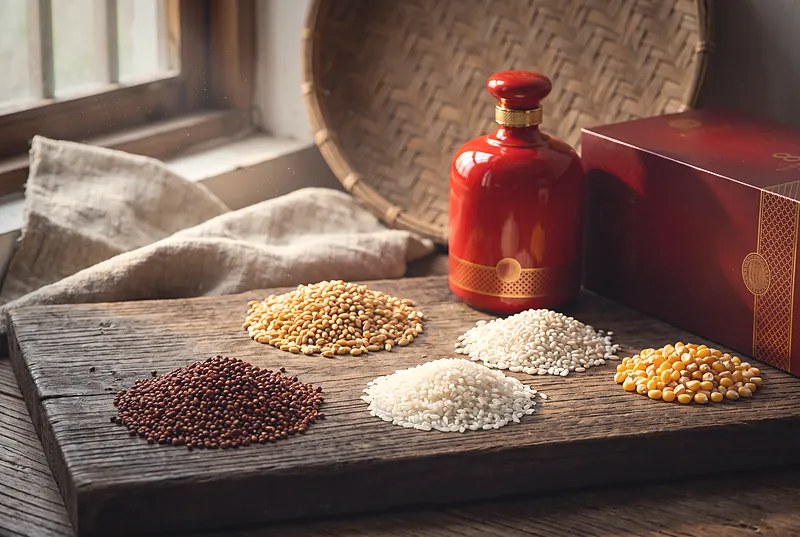
In early summer on the western Sichuan plain, the wheat has just gone into the granary and the rice paddies are turning green again. Grain is the root of baijiu, and within Sichuan's strong-aroma (nongxiang) tradition there is a school that ferments several grains together, usually called "multi-grain strong aroma". Qifu's flagship, Bainian Qifu · 8, is one of these: sorghum, wheat, rice, glutinous rice and corn, all fermented in the same pit.
A division of labour in one old saying
Distillers have a saying that goes roughly: sorghum for fragrance, corn for sweetness, rice for cleanness, glutinous rice for softness, wheat for punch 1. It sounds like a rhyme for apprentices, but each phrase carries generations of experience.
Sorghum is the backbone of Chinese baijiu. Its outer layers contain tannins and related compounds which, after steaming and a long fermentation, help produce aroma compounds, so it is regarded as the main source of fragrance. Corn is rich in starch and tends to give a rounded sweetness. Rice is clean and pure, and gives a crisp, tidy palate. Glutinous rice is sticky; it lends softness to the body of the spirit, but on its own it clumps, so it works best alongside other grains. Wheat is higher in protein and brings fullness and drive. In strong-aroma production, the daqu fermentation starter is usually made mainly from wheat as well, so wheat is both an ingredient and the foundation of the starter 12.
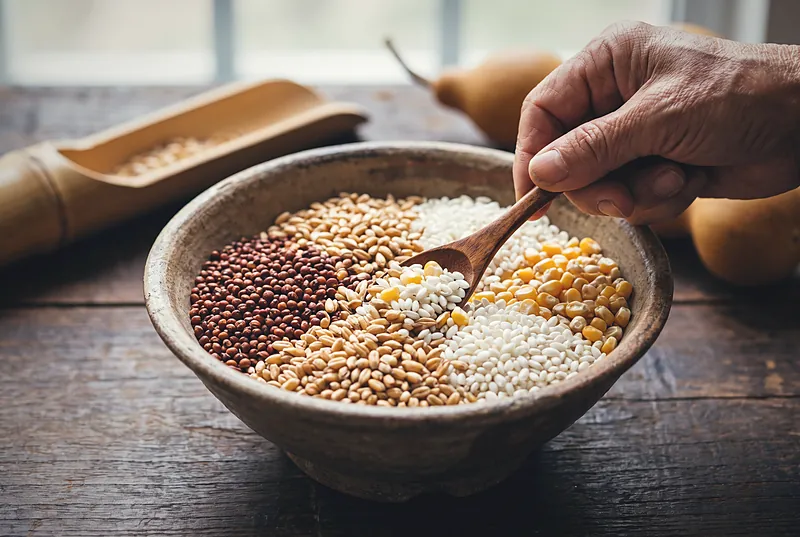
Why ferment five grains together?
A spirit made from a single grain tends to have a more focused flavour line. Several grains fermented together are more like an ensemble, each voice supporting the others. Because the grains differ in starch, protein and other components, they give the microbes in the pit a richer "menu", and the result is a spirit with more layers of aroma and texture.
The hard part is proportion. A little more of one grain or a little less of another changes the character of the spirit, and how finely the grain is milled or how long it is steamed must be adjusted with the season and the harvest. Much of this is not written down; it lives in the hands of people who do it year after year.
Bainian Qifu · 8: five grains, one spirit
Qifu is a family distillery in Mianzhu, at the foot of the Longmen Mountains, run by the same family since 1978. Bainian Qifu · 8 is made by solid-state fermentation: the grain goes into yellow-mud pits, sealed under a cap of red grain mash, for about two months. It is then distilled in a traditional zeng still, with the spirit graded and selected by quality as it runs, rested in clay jars, and finally composed by the master blender.
Pour a small cup and the entry is smooth, the sweetness lingers, the pit aroma is full, and the finish carries notes of nuts and caramel. Taste slowly and you may pick out the fragrance of sorghum, the softness of glutinous rice and the quiet drive of wheat. Five grains each doing their own work and then becoming one: it suits the name Qifu, "blessings, all together", rather well.
At 52% vol, this is a spirit for small cups and slow sipping. Next time you raise one, spare a thought for the five grains inside it, and for the patience it takes to bring them together.