
When it comes to Chinese poets and wine, Su Shi (1037–1101) is a name that cannot be avoided. Born in Meishan, Sichuan, and known by his studio name Dongpo, he excelled in poetry, prose, calligraphy and painting. His official career was a series of rises and falls and repeated exiles, yet he could always find composure in a cup of wine 1.
A light drinker with a big love of drink
Curiously, Su Dongpo said his own capacity was tiny. In an afterword he wrote to an older biography, he confessed:
予饮酒终日,不过五合。
— Su Shi, "Afterword to the Biography of Master Donggao"
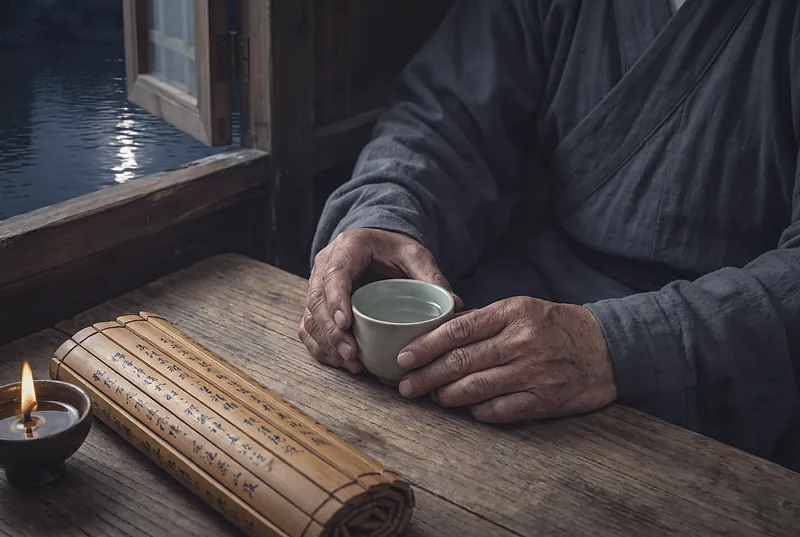
("Drinking all day, I manage no more than five ge.") He went on to say that no one in the world was a worse drinker than he, and yet he loved to watch others drink. When he saw a guest raise a cup and sip slowly, his own heart felt broad and at ease, and his pleasure surpassed even the drinker's. Loving wine without craving it: that was the Dongpo style.
Huangzhou, Red Cliff and a Daoist from Mianzhu
In 1080, after the "Crow Terrace Poetry Case", Su Shi was banished to Huangzhou. There he farmed a slope east of town and took the name Dongpo, "Eastern Slope". It was also in Huangzhou that he learned to make wine. In the preface to his "Song of Honey Wine", he writes that a Daoist from western Sichuan named Yang Shichang made excellent honey wine, and that having obtained the recipe, he wrote the song for him. Scholars have traced Yang Shichang's family roots to Mianzhu, where he practised at Wudu Mountain 2.
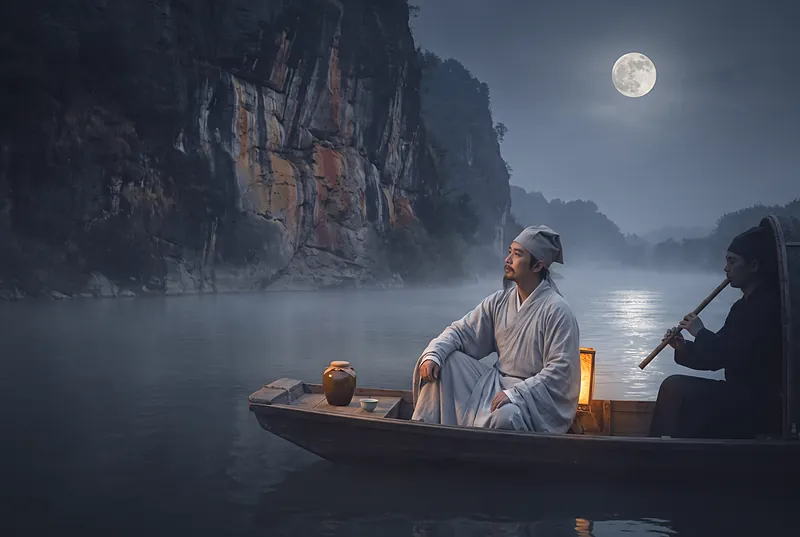
In the autumn of 1082, Su Shi and friends took a boat beneath the Red Cliff, and he wrote the "Rhapsody on the Red Cliff". In it he "raised his wine to his guests and recited a poem of the bright moon", while a gentle breeze blew and the water lay still. Among the guests was a man playing the vertical flute, and many have identified him as Yang Shichang 2. If so, there was a friendship from Mianzhu on the river that moonlit night.
His lyric "Recalling the Past at Red Cliff" from the same period ends: life is like a dream; let me pour one cup in offering to the river and the moon. A single cup offered to the water, the moon and all the heroes of the past.
Later Su Shi was sent further and further south, to Huizhou and then Danzhou on Hainan, yet he never lost his love of life. His writings show he kept brewing his own wine, and he left a short essay, the Dongpo Wine Classic, recording his method. For him, brewing, drinking and writing about wine were ways of finding some joy amid hardship.
Sichuan people and wine
Su Dongpo's attachment to wine reflects something of Sichuan more broadly: not heavy drinking, but a place for fragrance and friendship. Sichuan has long been known for fine spirits, and Mianzhu is one of its homes. The region's Jiannan Shaochun was offered as tribute wine in the Tang, part of the shared brewing heritage of the Mianzhu area, and the Southern Song scholar Zhang Shi (1133–1180) was born here too.
Today, at the foot of the Longmen Mountains, the Qifu family distillery continues that tradition with pure grain, solid-state fermentation in yellow-mud pits, zeng still distillation and ageing in clay jars. If you would like to love wine the way Dongpo did, without craving it, pour a small cup of Bainian Qifu · 8 or Qifu Laojiao, invite two or three good friends, drink slowly, and listen to them talk. You may find that same broad, easy contentment in your own heart.