
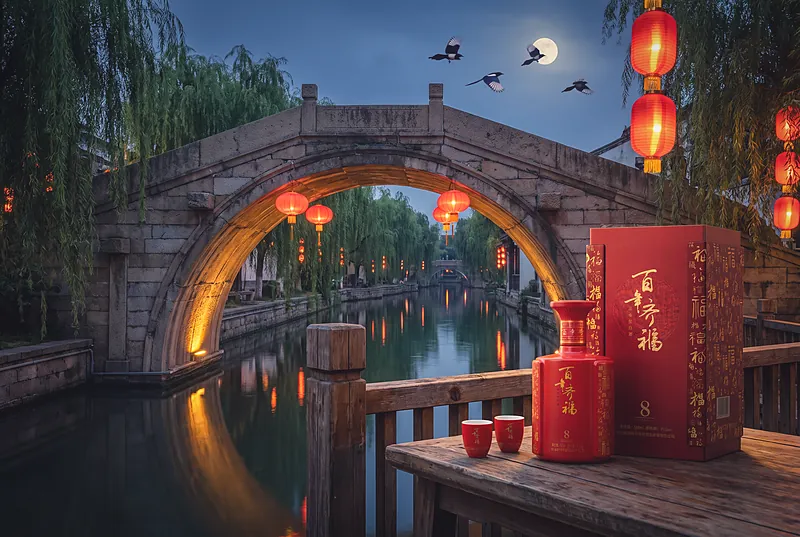
The seventh day of the seventh lunar month is when, in legend, the Cowherd and the Weaver Girl meet on a bridge of magpies. The festival has been celebrated in China for over two thousand years, and in 2006 it was included in the first list of China's national intangible cultural heritage 1. In centuries of poetry, Qixi brings the Milky Way, the magpie bridge and, often, a cup of wine.
Just one clear stream between them
The earliest poem to make the lovers truly moving is "Far, Far Away, the Cowherd Star" from the Han-dynasty Nineteen Old Poems:
Just one clear, brimming stream between them; gazing, they cannot speak.
— Nineteen Old Poems
A shallow river of stars separates two lights that look at one another. That longing for what can be seen but not reached became the undertone of Qixi poetry. In the Tang, Du Mu's "Autumn Evening" pictures a palace woman on Qixi night, lying beneath steps "cool as water" and gazing up at the Cowherd and Weaver stars, a loneliness she cannot put into words. In the Northern Song, Qin Guan offered another answer in his lyric to the tune "Immortals at the Magpie Bridge": if love is to last, why must it be morning after morning, night after night? A lasting bond does not depend on being together every day 3.
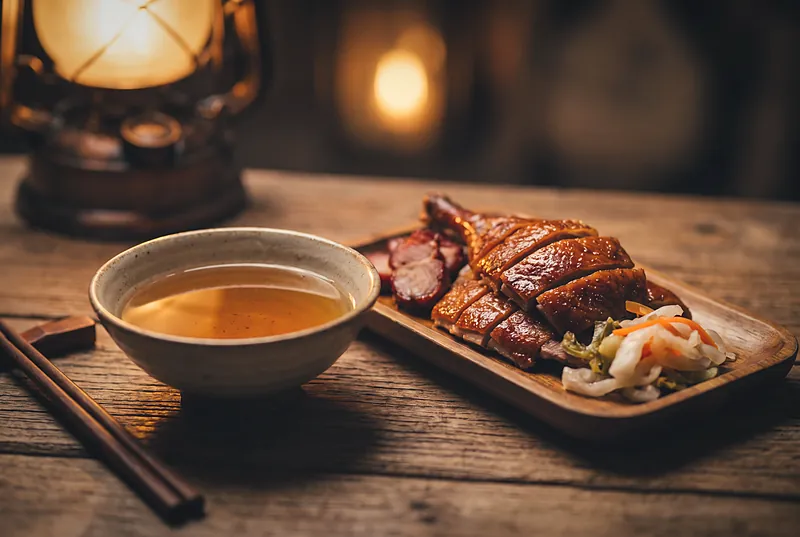
Wine and roast meat before the Begging Tower
If poets gave Qixi a gentle melancholy, ordinary people made it lively. Meng Yuanlao's Dongjing Meng Hua Lu, a memoir of the Northern Song capital Bianliang, describes how wealthy households built decorated "towers for begging skill" in their courtyards. Before them they laid out little clay dolls, carved melons, wine and roast meat, brushes and inkstones, needles and thread; children composed verses, young women showed their handiwork, and everyone burned incense and bowed 2. The wine and meat honoured the two stars above and served as a small festive meal for the family.
For people of the past, then, Qixi was not only a lovers' festival. It was also a night to wish for nimble hands and to gather the household together: begging for skill, bowing to the stars, watching the moon and sharing a modest drink.
A gift with a sense of proportion
Today Qixi has taken on more romantic ritual. Alongside flowers and chocolate, some people choose a gift with a little more weight: for a partner of many years, for a respected elder, or for an old friend not seen in a long while.
Bainian Qifu · 8 is Qifu's flagship: a red bottle in a red gift box with gold calligraphy. Red stands for celebration and completeness in Chinese culture, and the name Qifu means "blessings, all together". Made from five grains, sorghum, wheat, rice, glutinous rice and corn, at 52% vol, it enters smoothly with a lingering sweetness and a full pit aroma. On Qixi night, two people sitting together, two small glasses barely filled, a word from the heart as they touch rims: perhaps the gentlest answer to those lovers who "cannot speak".
Qixi wine is about feeling, not quantity. Sip slowly and keep a clear head, the better to count the stars with the person beside you.