
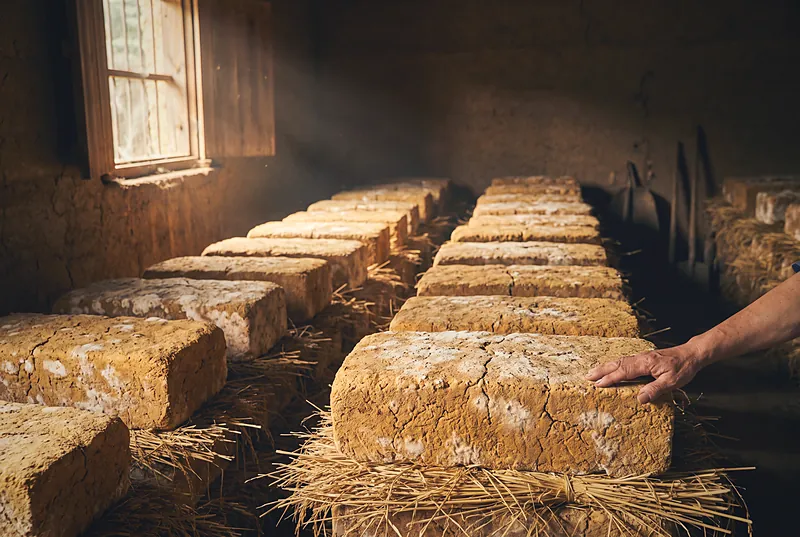
In the vocabulary of Chinese brewing, one word is unavoidable: qu. Grain does not turn into alcohol on its own. Its starch must first become sugar and the sugar then become alcohol, and that needs a starter. That starter is qu, and daqu, "big qu", is the most characteristic saccharifying and fermenting agent of Chinese baijiu 1.
Qu, three thousand years ago
Chinese writers recognised the power of qu very early. A line in the Book of Documents reads:
If I am making sweet wine, you shall be my qu and malt.
— Book of Documents, "Charge to Yue"
A Shang king compares a wise minister to the starter without which no wine can be made 3. In the sixth century, Jia Sixie's agricultural classic Qimin Yaoshu described several kinds of qu and how to brew with them in careful detail, one of the earliest surviving systematic records of starter-making 2.
Brewing with qu is a key difference between Chinese and Western traditions, which rely on malt to convert starch. In qu, moulds, yeasts and bacteria grow together, so the conversion of starch and the fermentation of sugar can happen in a single process. Many regard this as one of ancient China's great contributions to the craft of fermentation.
How a block of daqu is made
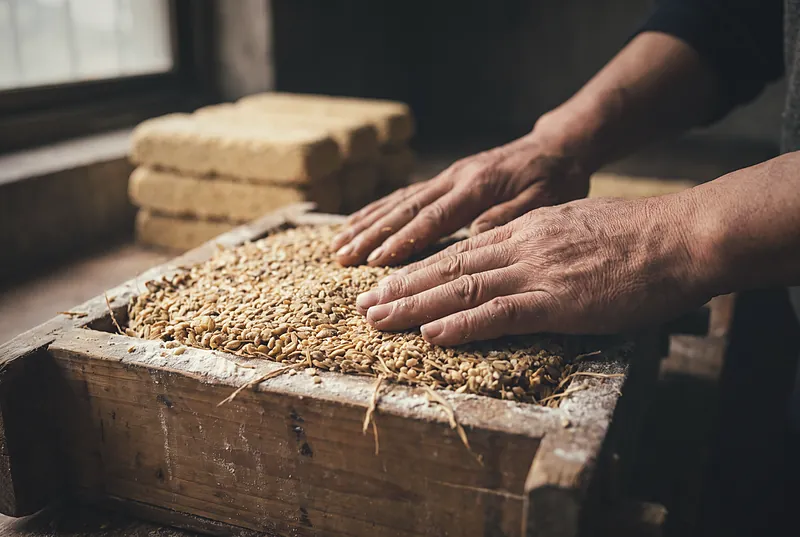
Daqu is usually made mainly from wheat, sometimes with barley or peas. The grain is crushed, mixed with water and pressed into brick-shaped blocks; in the old days workers trod them into shape with their feet. The blocks are then laid on straw in a warm qu room, where microbes from the surroundings gather and grow. The blocks heat up as they incubate, and daqu is broadly classed by its peak temperature: sauce-aroma baijiu tends to use high-temperature qu, strong-aroma baijiu medium-to-high-temperature qu, and light-aroma baijiu low-temperature qu 1. After several weeks of incubation the blocks are stored for a further period to settle before they are used.
Brewers have an old saying: "Grain is the flesh of the spirit, water its blood, and qu its bones." Good qu brings not only the power to convert and ferment but a wealth of flavour compounds. It gives a spirit its structure.
Qu and pit: where Qifu Laojiao comes from
In strong-aroma baijiu, daqu and the fermentation pit work as partners. At the Qifu distillery at the foot of the Longmen Mountains in Mianzhu, pure grain is mixed with qu and laid into yellow-mud pits, capped with red grain and fermented in solid state for about two months. It is then distilled in a traditional zeng still, cut by quality and rested in clay jars. The qu releases its strength slowly in the pit, the microbes of the pit mud work alongside it, and the rich pit aroma is born.
Qifu Laojiao 15 Year and 20 Year are the result of this old method and a great deal of time. The 15 Year is described as clean and sweet, firm yet gentle, with an elegant aged aroma and a soft, full body. That balance of firmness and gentleness owes something to the "bones" of the qu and the fragrance of the pit.
A plain brick of wheat carries thousands of years of brewing knowledge. Next time you raise a glass of strong-aroma baijiu, sip slowly from a small cup and taste the depth that begins with qu.