
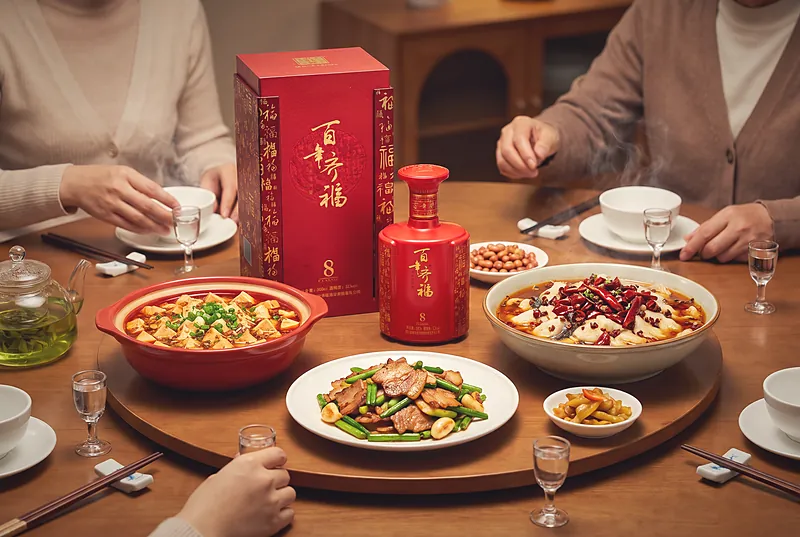
In Sichuan a good meal rarely comes without a good drink. Mapo tofu arrives red and bubbling, twice-cooked pork fills the room with its scent, and a bowl of "water-boiled" fish is layered with peppercorns and dried chillies. At a table like this, the cup people raise is very often a small measure of strong-aroma baijiu. Sichuan food and Sichuan spirits grew up in the same basin, and they understand each other.
One dish, one character
Sichuan cooking is often summed up as "every dish its own style, a hundred dishes a hundred flavours" 3. Beyond the famous numbing heat there are fish-fragrant, "strange-flavour", pepper-numbing and home-style profiles, among many others. The cuisine is far more layered than chilli alone. In 2010 Chengdu became the first city in Asia to be named a UNESCO City of Gastronomy 1.
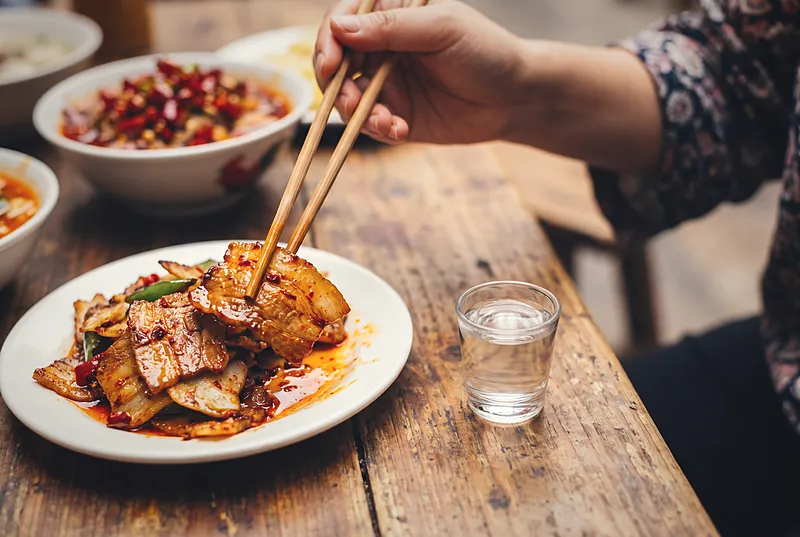
The classic home dishes each have a story. Mapo tofu is said to have been created in Qing-dynasty Chengdu by a woman named Chen, whose pock-marked face gave the dish its name 2. Twice-cooked pork is the taste of countless Sichuan homes: pork boiled, sliced and then stir-fried with Pixian bean paste and garlic shoots. Water-boiled fish is finished with hot oil poured over Sichuan pepper and dried chillies. Flavours this bold and deep call for a spirit with presence of its own.
Strong aroma meets heat
Strong-aroma baijiu is known for its rich pit fragrance and a smooth, sweet, clean finish. Its aroma is full enough not to be drowned out by bold food, while its soft sweetness and long finish answer the many layered flavours of Sichuan cooking. A bite of food, a small sip, and after the heat the pit and grain aromas slowly rise. Many Sichuan families know this rhythm well.
Pairing also takes judgement. Eat a few mouthfuls before raising your glass. Keep the cups small, sip a little at a time and let it rest on the tongue before swallowing. Keep a pot of tea or a glass of water within reach and alternate, so your palate stays clear and the pace stays relaxed. When the food is fiery, the drinking should be slow. That balance is the whole idea of the meal.
Everyday bottles and bottles for guests
The Qifu distillery sits in Mianzhu, on the northern edge of the Chengdu Plain, and shares its water and soil with these dishes. For an ordinary family dinner, a bottle from the everyday Jin Qifu range fits well, poured beside twice-cooked pork and a dish of peanuts while everyone talks over the day.
For festivals or honoured guests, Bainian Qifu · 8 is the natural choice. It is distilled from five grains (sorghum, wheat, rice, glutinous rice and corn) and bottled at 52% vol. It enters smoothly, with lingering sweetness, a full pit aroma and a nutty, caramel-like finish. Next to a table of Sichuan dishes, its red bottle adds to the festive feel.
Good food and good spirits are about everyone at the table having a fine time. Whatever you are eating, pour small, sip slowly and drink responsibly, and never drink and drive.